

Muhammad
Ahsan

The agency field guide

Social Measured

For digital agency owners

Get noticed. Earn trust. Keep clients. Your agency already knows how to make content. This connects what you publish to what your buyers need to believe, from their first encounter with you to their next renewal.

5 trust states · 9 levers · 1,000 starting points · 250 hooks

5

Buyer trust states, from
first encounter to renewal

1,000

Content starting points,
every one with an address

250

Hooks written in the words
agency buyers actually use

30

Days to install it,
alongside client work

01 The content gap

A full calendar. An empty pipeline. A quiet cancellation.

These can be the same problem. Your content shows that you are active. It does not show why someone should trust you with their business, or why the clients you already have should stay.

  • Attention without relevance

    You attract attention. From the wrong people.

    Tips other marketers already know. Trends your buyers do not care about. The likes go up, and the people who sign retainers still do not see their problem in what you publish.

    Start with the buyer's problem, in the buyer's words.
  • Claims without confidence

    You show the result. You hide the reason to believe it.

    Another dashboard screenshot does not tell a cautious prospect who runs their account, what happens in a bad month, or whether they can trust the number.

    Show the method, the team and the proof they can check.
  • Delivery without visible value

    You win the account. Then you stop earning the yes.

    The public content keeps coming. The proactive ideas, clear reports and useful client notes do not. At renewal, your client has forgotten why they chose you.

    Build a private content layer that makes value visible.

02 The big idea

Judged twice: your content is also a work sample

You sell marketing, so your own marketing is evidence. From most sellers a weak post is just a weak post. From you, it is also a sample of the work the buyer would be paying for.

Founder, Agency BB2B agency, 35 people · Tuesday

Your LinkedIn report says leads are up 40%. Your head of sales says they're tyre-kickers. Both are right.

Monday's pipeline meeting, in more than one software firm we work with. Marketing's number on one screen. Sales' list on the other: students, job-seekers, a rival vendor pricing the product. A handful could buy this quarter.

Nobody's lying. Marketing counts form fills. Sales counts conversations worth having. The head of marketing sits in the middle, defending a number she doesn't believe.

The gap is one sentence nobody has written down: what counts as a lead here.

I write about lead quality in B2B software every Tuesday. Follow if this is your Monday.

Illustrative example from the guide · Stage 1 · Lever: Mirror · AGY-S1-01-H1-A
“Do they understand a business like mine?”

Judged on what you say: the scene, the naming of the problem, the size of the ask.

  • 01Two voices the buyer hears every week, side by side. The scene has to be exactly theirs, because copy that makes readers relate it to themselves also makes them scrutinise it.
  • 02“Both are right” takes the blame out before anyone has to defend themselves. Blaming sales, the client or their current agency is the common mistake.
  • 03It names the gap, then stops. At Stage 1 the reader has not agreed there is a problem. The fix is next week's post, and the ask is only a follow.

The guide helps you answer both readings, with evidence, before you ask for the call.

03 Engine one · The journey map

Meet them where their trust is

Strangers need recognition. Prospects need proof. Clients need confidence. One kind of content cannot do all three, so every piece is written for one trust state, pulls one lever, and asks for no more than that state can bear.

Trust state 1 · 35% of output

Unaware: name the problem

“Why does the report say one thing and sales another?”

They do not know you, and have not agreed there is a problem worth solving. Earn recognition before you ask for attention. Most of your market is not buying this quarter, so most of your output starts here. Judging this stage on leads is judging seeds on soup.

The levers that fit

  • Mirror
  • Enemy
  • Open Loop
  • Confession
Your ask
Soft. Follow the founder
They keep
The idea
Judge it on
Saves, replies and follows from buyer job titles
Trust state 2 · 25% of output

Aware: prove it is possible

“Has anyone fixed this for a business like mine?”

They know the problem has a name. Now they need to believe it can be solved for a firm shaped like theirs, which is why proof belongs in the client's unit: booked surveys, sales-accepted leads, margin after returns. Not impressions.

The levers that fit

  • Reframe
  • Receipt
  • Echo
  • Open Loop
Your ask
Medium. Take the Agency Hiring Scorecard
They keep
Four answers to get in writing from any agency
Trust state 3 · 20% of output

Considering: demonstrate the machine

“Who logs into our account on a Tuesday?”

They are comparing three or four agencies, and a referred prospect has already looked you up. This is where most agencies publish nothing. A redacted client report, names out and everything else in, answers the question they will not ask aloud: will I understand your reports?

The levers that fit

  • Mechanism
  • Receipt
  • Confession
Your ask
Deep. Request a recorded 20-minute audit
They keep
The recording and a written summary
Trust state 4 · 10% of output

Deciding: remove the risk

“What do we own, and how do we leave?”

Proposals stall at “we'll think about it” when safety is missing: ownership, fees, notice and the first ninety days, in writing. One rule the guide will not bend: contracts before claims. No ownership or transparency claim goes out until your contracts already deliver it, because it is the first thing a prospect checks with a current client.

The levers that fit

  • Contract
  • Echo
  • Receipt
Your ask
Direct. A proposal meeting, or a 30-day paid sprint
They keep
The first-90-days plan, in writing
Trust state 5 · 10% of output

Client: turn delivery into proof

“Can I defend the renewal?”

Underneath the public ten percent runs a private layer no stranger sees: reports, quarterly reviews, unrequested ideas, client notes. It decides the renewal. And clients who won become Stage 1 distribution, which is the flywheel: referrals, “saw your work”, and the marketing lead who takes you to her next company.

The levers that fit

  • Echo
  • Contract
  • Receipt
Your ask
Participate. Review, refer, renew
They keep
Credit for their team

The starting mix is 35, 25, 20, 10, 10 across the five states. It is an operating principle of the system, not a law of nature: you rebalance it monthly towards the thinnest part of your own pipeline.

04 The content engine

One thousand starting points, each with an address

Less “what should we post?”. Five trust states say where the buyer is. Ten angles per state say what they are worried about. Five hooks open each angle, and four format families give it a shape. Dial one in.

5 × 10 × 5 × 4 = 1,000

Trust state S3 · Considering

Angle 2 of 10

Hook 1 of 5

Format family B · Video

AGY-S3-02-H1-B

Starting point 422 of 1,000

The redacted client report, section by section. Hook: “Names out. Everything else in.” Shape: a 60-second screen walk-through. It is the cell the guide uses to teach the address system.

Every piece in the guide has an address like this one, including private pieces such as a handover email or a quarterly review page. After ninety days you sort your ledger by it and see which trust job brought audit requests, and which cell never ran.

05 Engine three · The trust engine

Every piece is scored before it ships

Four trust variables, each rated 1 to 10 against written anchors, multiplied and divided by 100. Under 40 does not ship. From 40 to 65 you fix the weak variable. At 65 and above, you publish. Here is the guide's own worked example, the post you just read.

CTS = (Clarity × Consistency × Proactivity × Personalization) ÷ 100

41.0

8Clarity
8Consist.
8Proact.
8Personal.
  1. 00
    The draft: eight across the board.Shippable, not yet strong. Roughly 8 on every variable clears the line, and that is all it does.
    41.0
  2. 01
    Proactivity, 8 to 9.It names the gap but does not help close it. Add the agency's own definition of a lead, in one sentence.
    46.1
  3. 02
    Personalization, 8 to 9.“Software firm” is broad. Name the segment you serve, and one bad lead only that segment sees.
    51.8
  4. 03
    Clarity, 8 to 9.One clause opens a second argument. Cut it, and end on the sentence nobody wrote down.
    58.3
  5. 04
    Consistency, 8 to 9.No draft fixes this. “Every Tuesday” is a new promise, not yet kept. Post on Tuesday for eight weeks.
    65.6

Three variables can be edited up in an afternoon. Consistency is earned only by keeping the promise, and buyers read your publishing cadence the way they would read your report day. A high score is a structured assessment, not a forecast: audience fit, the offer and delivery still matter, and the guide says so.

06 Inside the guide

A field manual, not a book to finish

Sixteen parts in five blocks, in the order you would install the system. Read it front to back once if you like. After that, nobody should read it that way: start from the problem on your desk this week.

  1. 01
    Understand: Parts I to IVHow trust works when you sell marketing, the five trust states, the nine levers in agency language, and the four variables read as account management.
  2. 02
    Decide: Parts V to VIIOne vertical, one unit of proof, the seven pillars, the words buyers use, fifty content cells and the 250-hook library.
  3. 03
    Make: Parts VIII to XIIIWritten content buyers can check, eleven video formats, email from newsletter to client note, paid media when your ads are also your portfolio, and proof without breaking a contract.
  4. 04
    Measure: Part XIVThe agency trust dashboard and the Trust Content Ledger, reported like a client account.
  5. 05
    Install: Parts XV and XVIThirty days alongside client work, then the ninety-day ascent from verification pack to quarterly review peaks.
  6. 06
    A month of agency content, finishedFifty-eight finished pieces, so you can see the system at full stretch before you start.
  7. 07
    The toolkitTwenty-three worksheets, twelve checklists to laminate, and indexes of every job, template and call to action.
  8. 08
    References and evidence notesEvery claim labelled as research, operating principle or practitioner judgement, so you know how much weight it bears.

871 pages of reference material. Begin with the five-minute start: one leak, one post, one score. You do not have to read it cover to cover.

How the guide asks to be used

07 Before you get the guide

A few useful answers

Is this for my agency's content, or my clients' content?

Your agency's. It is written for marketing your own agency and strengthening your client relationships. The buyer throughout the guide is the person who hires, keeps or fires an agency.

Do I need to read all 871 pages?

No. Begin with the five-minute start and your current bottleneck. The page count includes extensive examples, the content starting points, worksheets and references. It is a field manual to return to as you work.

What kinds of agencies does it cover?

Independent agencies of roughly 5 to 50 people. Examples span paid media, SEO, social, creative, web and CRO, across local businesses, ecommerce and B2B, through three recurring composite agencies.

Is this a course or a subscription?

Neither. It is the complete digital PDF field guide, bought once through Gumroad. The frameworks, examples and worksheets are all inside it.

Will it guarantee leads, or stop clients leaving?

No, and it says so up front. Recognition moves in weeks; signed work moves in months, on the buyer's timetable. And it will not fix delivery: if reports arrive late and clients drift at month four, better content only brings more people to notice.

Can I learn the method without buying anything?

Yes. Social Measured is an open framework, and the core method is taught in full on this site. The agency guide is the same system worked all the way through for one kind of business, with the cells, hooks, templates and install plan written in agency language.

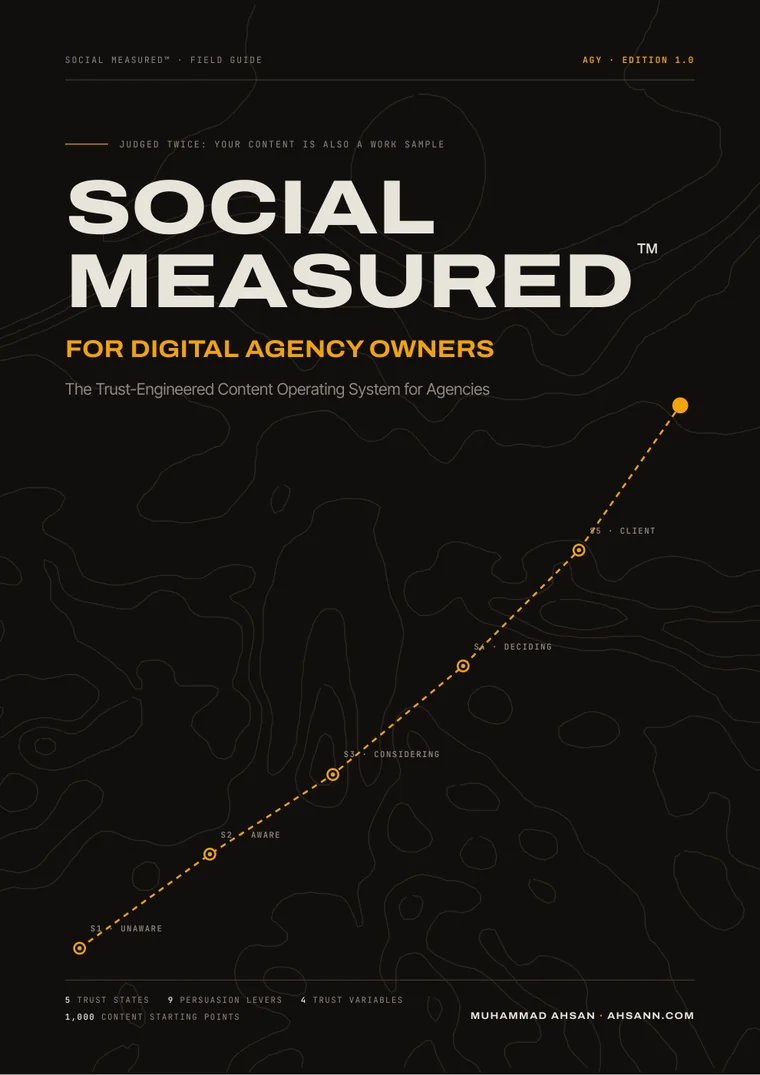
The cover of Social Measured for Digital Agency Owners, a field guide by Muhammad Ahsan

08 The field guide

Social Measured

For digital agency owners · Agency edition 01

  • Strategy that starts with the buyer. Five trust states, nine persuasion levers, and the Content Trust Score with its written anchors.
  • A repeatable content engine. 1,000 starting points, 250 agency hooks, and the execution shells that turn one idea into four shapes.
  • Proof that helps people choose you. Redacted reports, named teams, recorded audits, and receipts in the client's unit.
  • Content that protects the renewal. Reports, quarterly reviews and unrequested ideas, run as part of the system.
  • A plan your team can run. The 30-day install, the 90-day ascent, the trust dashboard, worksheets and finished examples.
  • Digital PDF
  • 871 pages
  • Edition 1.0, September 2026

Gumroad handles the checkout and sends you the file, and it always shows the current price. You can copy the templates, worksheets and checklists to create your own content and run your own team's workflow. Every example in the guide is an illustrative composite, never a claim of results.

For you if

  • You run an independent agency of roughly 5 to 50 people and still carry the new-business number.
  • Your team delivers under your brand, on retainers or on projects that should become retainers.
  • Referrals built the agency, and you want a pipeline you can predict.
  • You will show how you run accounts, including late reports, bad months and the client who left.

Not for you if

  • You pitch for a network in procurement-led reviews. When a scoring grid decides, content is a minor lever.
  • You sell productised work on price. This system raises trust. It cannot win a price war.
  • You run a white-label shop. Nobody comes to trust a name they never see.
  • You sell courses to agency owners. Every example assumes the buyer is an agency's client.

Social Measured applies trust to your content. For the client relationship behind it, the companion is Trust Measured. If you would rather have someone own the content operation with you, that is a conversation.

Next step

You do good work. Make it easier to believe.

One leak, one post, one score, this week. Then make every piece earn its place. If you would rather talk through where your own buyers lose trust, the discovery call is free and you keep the roadmap either way.

  • Built for agencies
  • Start in five minutes
  • Install in thirty days