

The nonprofit advertising field guide
NGO Measured™
Score it before you ship it.
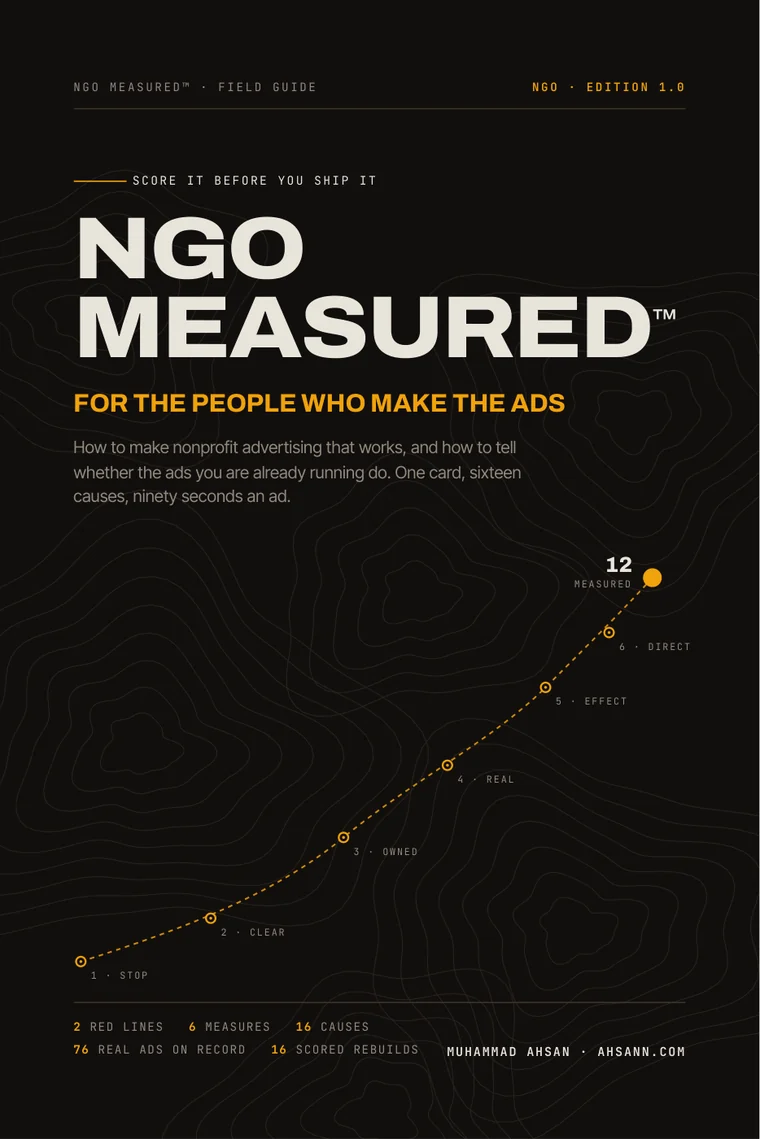
A donor can care deeply and still scroll past. Making the appeal more emotional does not tell you why. The Measured Card does: two red lines, six measures, a score out of twelve, about ninety seconds an ad. Then sixteen cause playbooks for building the next one.
2 red lines · 6 measures · 16 causes · 76 real ads on record
90s
To score one ad,
once you know the card
16
Cause playbooks,
each in the same format
76
Live nonprofit ads on record
from the Meta Ad Library
60m
To audit your last ten ads
and name the weakness
01 The argument
The case here is commercial, not moral
Before you read a single piece of advice, find out whether the platform is already charging you for the creative you run now. The column that tells you is free, and it is already in your account.
Do this now · 5 minutes, one login
- Open Ads Manager and go to the Ads tab, not Campaigns.
- Set the date range to the last 35 days. That is the window the diagnostic covers.
- Customise columns, and add Quality ranking, Engagement rate ranking and Conversion rate ranking.
- Sort by Quality ranking.
- Write down two numbers: how many ads you ran, and how many sit at Below average.
Meta publishes that ads with a lower quality ranking tend to cost more and reach fewer people, and that the signals feeding it include people hiding the ad or reporting it. People reaching for the hide button is not a soft reputational worry. It is an input to what you pay.
You do not have to break a rule to be charged more. And the charge is contagious: it can attach to the Page, the domain and the ad account, not only to the ad that caused it.
- Above average
- This creative is not being taxed. Leave it running, and score it anyway.
- Average
- Nothing to act on, nothing to celebrate. Score it, and look at Effect and Direct first.
- Below average
- This creative costs more than it needs to, every day it delivers. Pausing it costs you nothing.
The catch, and the guide says so: Meta has never published that charity suffering imagery causes hides and reports. Whether yours does is a question about your audience, not a fact about the sector, and this column is where you answer it.
02 The instrument
The Measured Card. Score one ad now.
Open one live ad on a phone. Score what is on the screen, not what you know about the programme. Between two scores, choose the lower. Nothing is sent anywhere and nothing is stored.
Step 1 Name the ad type
Money, now. Effect means what the money does. Direct means a specific amount.
Step 2 The two red lines
Dignity
Would the person in this ad accept being shown this way?
Truth
Can you prove every number, date and claim today?
Step 3 The six measures
Step 4 The read
Rebuild the weakest half
Score the six measures and the card names the one to fix first.
Try three from the worked audit
The last rule is the one people try to negotiate with. A zero is a hole, and a high total with a hole in it is an ad that will fail for one reason you already knew about. A red line is not a seventh measure either. It is a gate: fail it and you do not record a total, you do not average it, and you do not trade it against a strong measure somewhere else.
03 The playbooks
Sixteen causes, and the trap in each one
Twelve categories the sector runs by name, then four more if you need them. The trap is what almost everyone in that category does, taken from live ads, and the first thing to check in yours.
Healthcare
Selling the capability, never the price: nothing named or costed.
That is one field of ten. Every cause page in the guide is built the same way, so you learn one and can read all sixteen:- Who gives, and why
- What they are quietly asking
- The emotion that works
- The emotion that backfires
- What they need to see to believe you
- Say this, not this
- The CTA set
- Three hooks
- The trap
- One number to measure
A pattern everybody runs is a pattern nobody stands out in. The trap column tells you what to check first, not what your account is doing, which is why the guide makes you score your own ads before you open your cause page.
04 The diagnosis
Four things must be true before anyone gives
When a campaign is not working and nobody can say why, one of these is missing. More emotion only ever fixes the first, which is the one most appeals already have.
- 01
They care.
The cause matters to them. Most appeals stop here and turn the volume up.
- 02
They believe it can be fixed.
A problem that sounds bottomless earns sympathy and no gift.
- 03
They believe you.
A name, a number and a place they could check in one click.
- 04
They can act.
One step away, sized to how well they already know you.
- Temperature one
Cold
They have never heard of you. Say the cause in the first four words, and do not ask for what only a friend would give.
- Temperature two
Warm
They know the name. This is where the named appeal works, and where it is wasted if you run it anywhere else.
- Temperature three
Hot
They have given before. The ask gets specific, and the report-back starts paying for the next campaign.
Which of the three you are talking to decides the ask on every page of the guide. Part 3 covers what to make for each, the emergency exception, and the mismatch table that explains most of what gets blamed on the creative.
05 The limits
What this guide refuses to do
It will also not tell you that a platform bans sad photographs, because none of them does. The real rules are narrower and more useful, and they are quoted from the platforms' own published pages.
- Refusal one
It will not tell you to make people feel guilty
Guilt aimed at the reader is the sector default. It is also the weakest option on the table, and the case against it here is commercial, not moral.
- Refusal two
It will not invent a number
Every figure is traceable to a platform's published policy, to the Ad Library pull, or to your own account. Names, costs, dates and places in the examples are blanks for you to fill with facts you can prove.
- Refusal three
It will not pretend anyone has settled what works
Where the evidence runs out, the guide says so and gives you the test to run yourself, including how to tell whether you have enough volume to test at all.
06 The contents
Eleven parts, read in the order you need them
Three doors in. Audit what you are already running, make something new, or find out why a campaign is not working. The card sits at the top, and everything under it exists to raise a measure that scored badly.
- 01Start here: audit what you are already runningThe five-minute proof, the Measured Card, the sixty-minute audit, and calibrating two scorers.
- 02The sixteen causesOne playbook each: the emotion that works, the trap, the words, three hooks.
- 03Where your donor isCold, warm and hot. The emergency exception and the mismatch table.
- 04What actually drives a donorThe four conditions, which one is missing, and the fix index.
- 05Emotion: what works and what backfiresWhat the platforms actually enforce, the one-line test, and twelve rewrites.
- 06The creative libraryStatic, carousel, video, creator content, and what to make with no budget and no footage.
- 07The wordsSix hook families, four copy formulas, subject lines, the ask line.
- 08The donation pageTwelve components in order, the amount array, the monthly ask, the thank-you page.
- 09After the giftThe first ninety days, the report-back, monthly giving, supporters who stop.
- 10Measurement without a data teamFive numbers that matter, what the platform report is not telling you, the cost of a bad ad.
- 11The first ninety daysWeek by week, with a one-person variant and what should be true on day 90.
- +AppendicesEvery card and checklist, the sixteen causes on one spread, sources, and a glossary.
07 The field guide
NGO Measured™
For the people who make the ads
- The Measured Card and the sixty-minute audit. Grade your last ten ads, rank them, and name the one weakness to fix first.
- Sixteen cause playbooks. The emotion, the trap, the words and three hooks for each.
- Seventy-six real ads on record, sixteen scored rebuilds. What the sector actually runs, beside clearly labelled illustrative creative.
- Creative, copy, donation page and follow-up. From the first line of the ad to the report-back that funds the next one.
- Measurement and a ninety-day plan. With a variant for the team that is one person.
- Digital PDF
- 194 pages
- Edition 1.0, September 2026
Gumroad handles the checkout and sends you the file, and it always shows the current price. You can copy the card, the worksheets and the checklists to score and brief your own ads and your clients' ads. Where the guide discusses platform policy, charity law and consent, it summarises public guidance so you know what to ask. It is not legal advice.
Who it is for
- A media buyer new to the sector, who leaves with a score for every ad in the account and the first fix.
- A communications officer who inherited the account, who leaves with a cause playbook and a brief to hand a designer.
- A trustee reviewing a draft, who gets one page to hold it against, with no training.
- Agency creatives and fundraisers who make, buy or sign off nonprofit ads. No media background needed.
Who it is not for
- Anyone who wants a guilt formula. The guide argues against it on cost, and shows you the column that proves it.
- Anyone who wants sector benchmarks handed to them. Where a number cannot be sourced, the guide leaves a blank rather than fill it.
Next step
Open one live ad on a phone. Say aloud what it is asking you to do.
If you cannot, you have found your first fix. If your organisation would rather have someone own the whole growth function than one campaign, the discovery call is free and you keep the roadmap either way.